Tibet Travel Permit: Where You Need One—and Where You Don’t
For tourists travelling on foreign passports, a Tibet Travel Permit is required to visit the Tibet Autonomous Region (TAR), including Lhasa. The requirement does not extend to every Tibetan cultural area in China. Chinese consular guidance.
You do not need that permit to visit Gannan, Qinghai's Tibetan prefectures, Garze or Aba in Sichuan, or Shangri-La in Yunnan. These places are outside the TAR.
Where the permit applies
| Destinations | Province or region | Tibet Travel Permit? |
|---|---|---|
| Lhasa, Shigatse, Mount Kailash, Mount Everest (Tibet side) | Tibet Autonomous Region | Yes |
| Xiahe / Labrang, Langmusi, Zhagana | Gannan in Gansu; Langmusi straddles Gansu and Sichuan | No |
| Xining, Tongren / Repkong, Yushu, Golog | Qinghai | No |
| Kangding, Tagong, Danba, Litang, Daocheng Yading, Ruoergai | Garze and Aba in Sichuan | No |
| Shangri-La, Deqin, Meili Snow Mountain, Yubeng | Deqen / Diqing in Yunnan | No |
Entry into a designated foreigner-restricted area requires separate approval, including outside the TAR. China's Exit and Entry Administration Law, Article 44.
For example, staying in Xining or visiting Tongren does not require a Tibet Travel Permit. Continuing from Xining to Lhasa does—the destination is now inside the TAR.
Tibetan cultural regions and the TAR
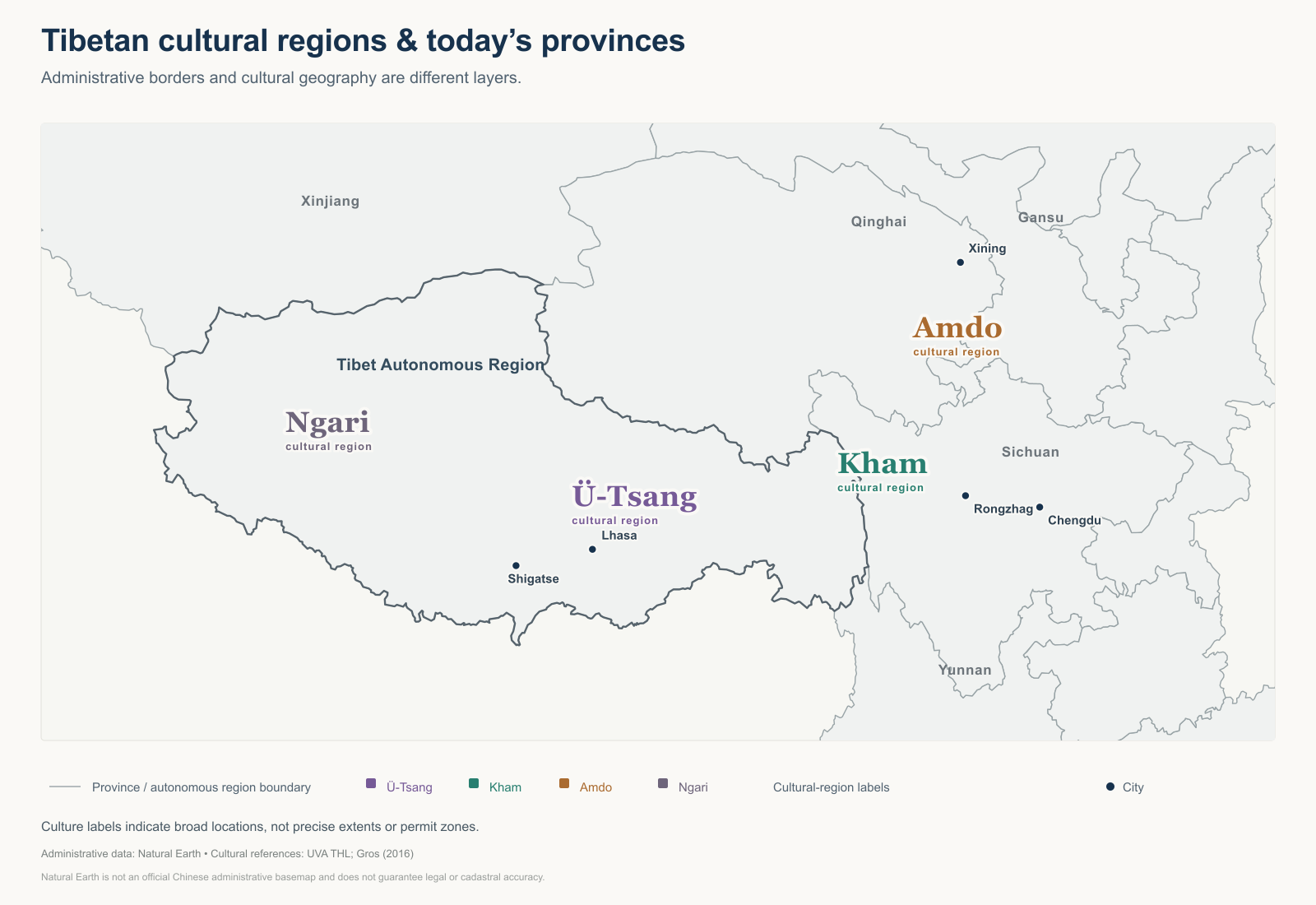
Ü-Tsang, Kham and Amdo describe historical and cultural regions, not three permit zones. Tibetan communities extend across today's provincial boundaries: Kham, for example, includes areas both inside and outside the TAR.
Travelling in the TAR
Foreign tourists need an organised itinerary as well as the permit. Arrange TAR travel through an authorised travel agency; obtaining a permit does not make it a destination for independent travel. UK government travel guidance.
A Chinese visa—or visa-free entry to China—does not replace the Tibet Travel Permit. If you are using visa-free transit, the policy's permitted travel areas also limit your itinerary, even for destinations that do not require a Tibet Travel Permit. See the visa-free entry and transit guide and NIA transit rules.
Border-area permits
A border-area permit is a different document, for designated areas along China's international land border. Crossing between Gansu and Sichuan at Langmusi is a provincial crossing, not an international-border crossing; it does not itself trigger this requirement. See the NIA border-area guide.
If your itinerary requires an electronic border-area permit, foreign applicants must apply in person at a public-security exit/entry office or designated police station. The online application channel is for eligible mainland Chinese residents. See the NIA application guide.
Shigatse border routes — notice checked 5 September 2026. The NIA announced a suspension of electronic border-area permits for Shigatse from 28 August 2026 and advised holders whose permits include Shigatse not to travel to the affected areas. See the NIA notice for the affected permit and any subsequent updates.
Detailed sources
- Chinese consular guidance on travel to the TAR
- NIA, Exit and Entry Administration Law, Article 44
- UK government travel guidance for China regional risks
- Ruoergai County government description of Langmusi
- Yunnan Department of Natural Resources administrative source for Diqing
- NIA transit rules
- NIA electronic border-area permit application guide
- NIA notice on the Shigatse electronic border-area permit suspension